Top Signs You Need Garage Door Service – Don’t Ignore These
A garage door that takes two seconds longer to open than it did six months ago isn’t aging gracefully. It’s telling you a spring has lost tension and is transferring load to your opener motor, shortening its life by months. The door still works, until the morning it doesn’t. Most garage door failures in Parsippany don’t happen without warning. They announce themselves through specific, missable signals that homeowners dismiss as “normal door quirks” until a spring snaps or a cable frays completely. Here’s how to read those signals before they cost you a morning, or more.
Key Takeaways
- Slow, jerky, or uneven movement is usually a spring tension problem, not a motor problem.
- Grinding, popping, and rhythmic clicking are mechanical warnings; creaking and light settling noise are normal.
- The manual lift test is the fastest way to check whether your springs are still balanced.
- Frayed cables, worn rollers, and cracked bottom brackets are visible before they fail.
- Ignoring one worn component speeds wear on the parts next to it, turning a small repair into a bigger one.
How do I tell normal wear from a real mechanical problem?
Every garage door makes noise. The question is which noises mean something. Cosmetic wear is slow, even, and predictable: light creaking as the door settles, a faint hum from the opener, a little rattle when the panels move. Mechanical warning signs are sharper and more irregular. In our experience working on doors across Parsippany, the sounds below deserve a look before you assume they’ll sort themselves out.
- Grinding that grows louder through the travel usually points to dry or worn rollers, or a track that’s out of alignment.
- Popping or snapping is the sound of a spring under load. Stop using the door and have it checked.
- Rhythmic clicking once per rotation often comes from a damaged roller bearing or a bent hinge.
- Creaking or groaning at the same spot each time can be a loose bracket or a panel that’s shifted.
The rule of thumb we give homeowners: if the noise is new, gets worse over a few days, or changes pitch mid-travel, treat it as mechanical. If it’s been the same soft creak for years, it’s probably just your door being a door. When in doubt, a short diagnostic visit settles it. Diagnose first, replace only if necessary – we’d rather tighten a bracket than sell you a door you don’t need.
What does the opener overexertion test tell you?
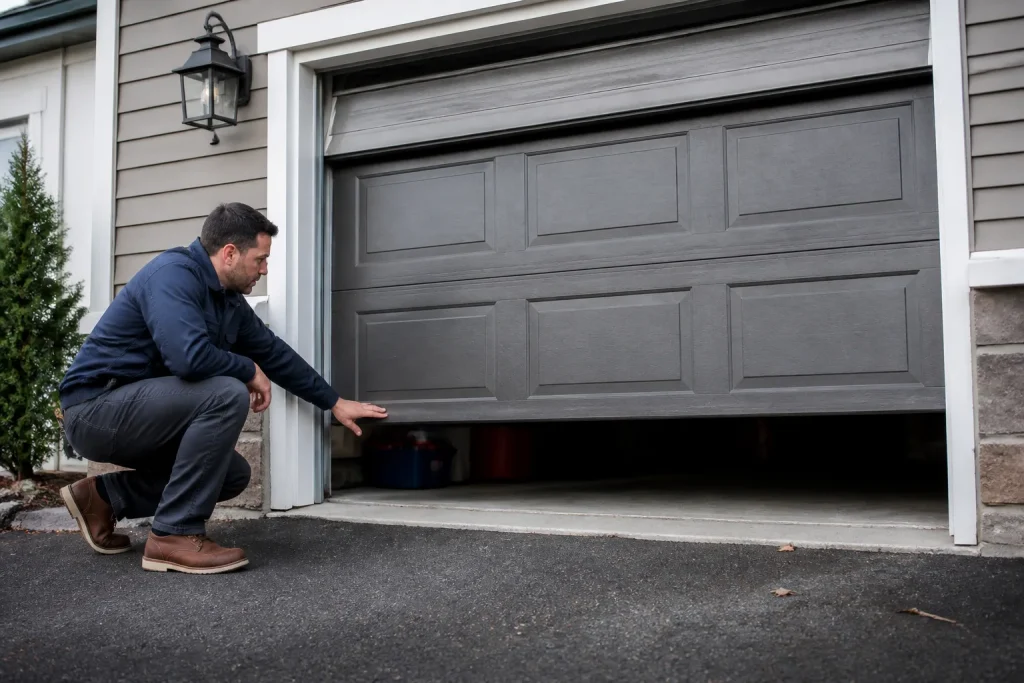
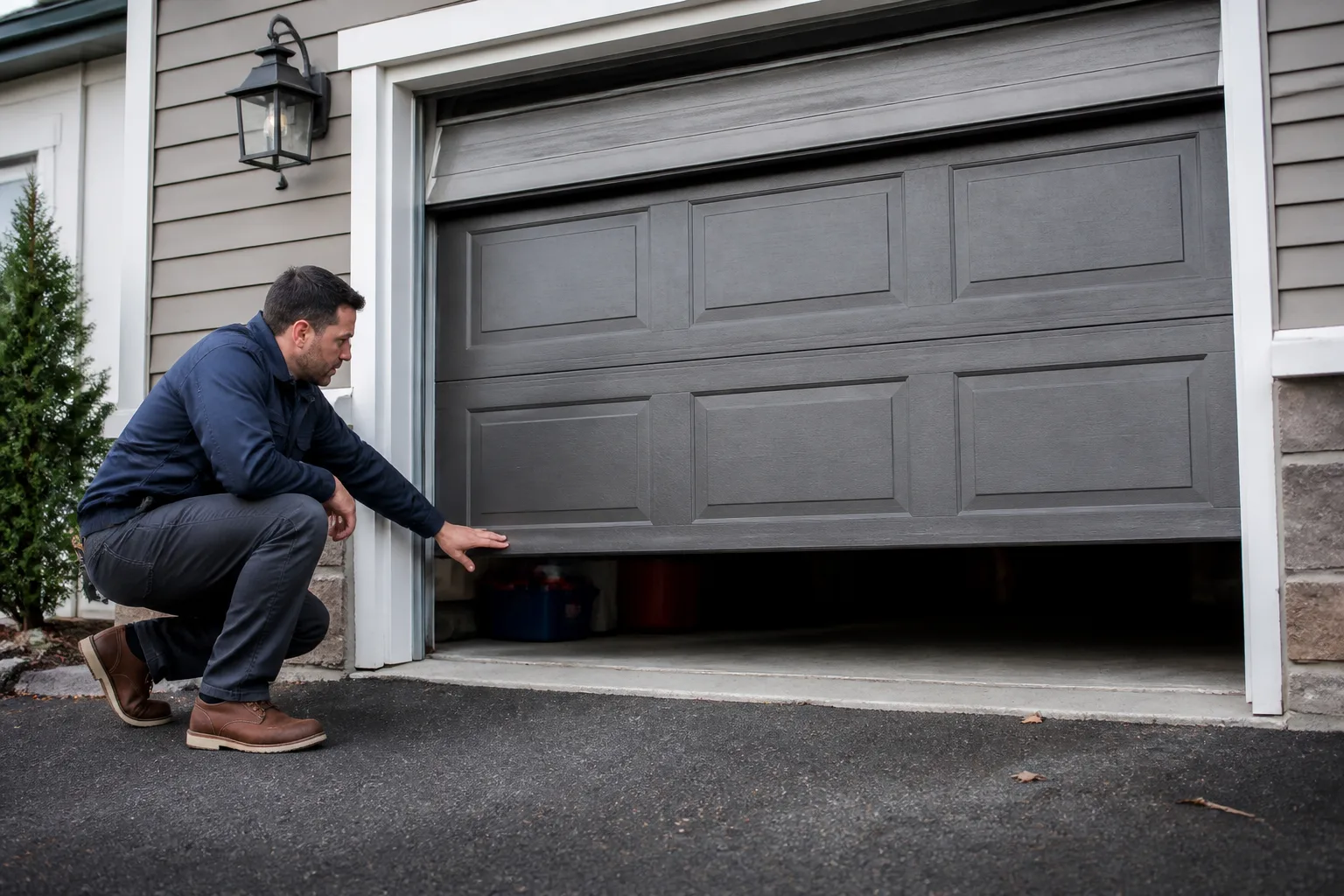
It tells you whether your springs are still doing their job or whether your opener is quietly doing the springs’ job for them. A balanced door should lift smoothly with one hand and stay put when you let go at the halfway point. If it feels heavy, drifts down hard, or won’t hold position, the springs have lost tension and the motor is picking up the slack. That extra load wears the opener’s gears and motor prematurely.
- Close the door and pull the manual release cord to disconnect the opener.
- Lift the door by hand to about waist height. It should move easily and evenly.
- Let go at the midpoint. It should stay roughly where you left it.
- Reconnect the opener and run the door once to confirm it re-engages.
A safety note: this test involves only lifting the door by hand – nothing more. Do not attempt to adjust, lubricate, or touch the springs, cables, or bottom brackets yourself. Those carry high tension and can cause serious injury. That’s the job for a trained technician, and it’s exactly the kind of work most general handymen decline. If the lift test feels heavy or the door won’t hold position, call us and we’ll check the spring system properly.
Which parts should I be inspecting that most homeowners never check?
The four spots below fail quietly, and each one is visible if you know where to look. This is the short list we check on every visit to a Parsippany home, because these components usually announce themselves weeks before a breakdown.
- Cables at the drum. Look at the top corners where the cable winds. Fraying, kinks, or a fuzzy appearance means the cable is failing. A snapped cable lets the door drop on one side, so treat any visible wear as urgent.
- Roller bearings. Worn steel rollers develop flat spots and wobble; nylon rollers crack. Check them by looking for chips and listening for the rhythmic clicking above.
- Bottom bracket stress cracks. The bracket connecting the cable to the door can crack from repeated load. Hairline fractures are a red flag – and never loosen or remove these yourself.
- Weather seal compression. A flattened bottom seal lets in water, cold, and pests. If you can see daylight under a closed door in Parsippany, or the seal looks crushed flat, it’s due for replacement.
None of these require you to take anything apart. A flashlight and a slow walk around the door with it closed, then open, is enough to spot most of them.
How do I know if my door is operating outside safe parameters?
A door that “still works” can still be unsafe. Two benchmarks tell you more than anything else: how long it takes to close, and how it responds when it meets an obstacle. Test both with the door at normal speed, then judge against the manufacturer’s reversing requirement in your opener manual – most modern openers are designed to reverse on contact with a small obstruction. If your door doesn’t respond as the manual describes, it’s a safety issue, not a maintenance preference.
- Response time: if the door takes noticeably longer to start, or labors on the way up, the system is under strain.
- Reversal sensitivity: place a small object (a rolled towel or a piece of wood) under the door and close it. The door should reverse on contact. If it presses down instead, the safety system needs attention.
- Photo-eye alignment: the sensors near the floor should have solid indicator lights on both sides. A flickering or dark light means the door may not reverse at all.
We work on the brand you already have, so whether your opener is a Genie or a LiftMaster, the test is the same and the fix is usually straightforward. A door operating outside safe parameters is one of the strongest signs you need garage door opener repair.
Why does one worn part lead to a bigger repair?
Because the parts of a garage door share load. When one component starts to fail, its neighbors pick up the extra work and wear faster. That’s the cascade pattern, and it’s why a small fix left alone for a season can grow into a much larger job. Ignore a worn roller and the door runs slightly out of alignment; that misalignment loads the track, stresses the hinges, and puts uneven tension on the springs.
We see this on doors around Parsippany all the time: a homeowner notices a noisy roller, waits a few months, and ends up needing rollers, a track adjustment, and spring work in one visit. The good news is that catching the first worn part early keeps the rest of the system healthy. A simple rule: if one component is showing wear, check the parts it touches before they show wear too. Springs, openers, panels, tracks – the whole system works together, and it’s worth looking at it that way.
When should you call a pro?
Call a garage door specialist when any of these are true for your door in Parsippany: the manual lift test feels heavy; a spring has snapped or the door won’t stay up; a cable is frayed, kinked, or slack on one side; the door reverses unevenly or won’t hold its position; a bottom bracket is cracked; or the opener is straining to lift a door that used to glide. Springs and cables especially are high-tension, safety-critical parts – a job most general handymen won’t take on, and shouldn’t. Our technicians have up to 8 years of experience and specialize in spring repair, which means the right tools and the right training for the most dangerous part of the system. If your door is stuck right now, we offer emergency service – when your door won’t move, we will.
Related services in Parsippany: if you’ve spotted any of these signs, garage door repair covers the whole system, and for a spring that’s already gone, garage door spring repair is the place to start. Not sure which you need? Start at Parsippany Garage Door Repair Pros and we’ll point you the right way.
The Bottom Line
Garage doors rarely fail without warning. They grumble, slow down, and drift out of balance long before something breaks. If you watch for the signals in this post – the new noises, the heavy manual lift, the frayed cable, the sluggish reversal – you’ll usually catch a problem while it’s still a small repair. The one rule we’d leave you with: never touch the springs or cables yourself. If anything above sounds like your door, stop running it and have it checked. If you’re in Parsippany and need help, Parsippany Garage Door Repair Pros offers free estimates – call (866) 643-7636.
Frequently Asked Questions
The first signs are usually a door that moves slower or more jerkily than it used to, new grinding or popping noises, and a door that feels heavy when you lift it by hand. Any of these points to a spring, roller, or opener problem worth checking. Call (866) 643-7636 for a free estimate.
No – springs and cables are high-tension, safety-critical components, and adjusting them without the right tools and training can cause serious injury. That’s why most general handymen won’t touch them. Leave spring work to a trained technician and call us instead.
Not always. Light, steady creaking is normal wear. Grinding, popping, rhythmic clicking, or any noise that’s new and getting worse signals a mechanical problem worth inspecting. If the sound changes over a few days, treat it as a warning.
Disconnect the opener with the manual release and lift the door halfway by hand. A balanced door lifts easily and stays in place; an unbalanced one feels heavy or drifts down. Don’t touch the springs or cables yourself – just note the result and call (866) 643-7636 for a proper check.
Written by the team at Parsippany Garage Door Repair Pros.
Need Garage Door Help?
Call Parsippany Garage Door Repair Pros - the local pro we connect you with is licensed and insured, here with fast after-hours help in Parsippany.
(866) 643-7636